Posts Tagged ‘Don’t Get Fooled Again’
UK trade unions condemn restrictions on press freedom and civil liberties
The UK Trade Unions Congress has endorsed a motion by the National Union of Journalists expressing ‘grave concern’ over the erosion of civil liberties in the UK, and the effect that this is having on freedom of expression.
“The terrorising of journalists isn’t just done by shadowy men in balaclavas, but also by governments and organisations who use the apparatus of the law or state authorities to suppress and distort the information they do not want the public to know and to terrorise the journalists involved through injunctions, threats to imprisonment and financial ruin,” NUJ General Secretary Jeremy Dear told the conference.
Dear cited the case of Sally Murrer, who is currently on trial for allegedly receiving information from a police officer that he had not been authorised to disclose, and the treatment by police of press photographers in a raid on the “Climate Camp” protest earlier this year.
“Journalists’ material and their sources are increasingly targeted by those who wish to pull a cloak of secrecy over their actions.”, Dear told the conference.
In a similar vein, Craig Murray reports being pressured to making swingeing changes to the text of his new book, “The Orangemen of Togo” (great title!) after Tim Spicer, formerly of the mercenary company Sandline, and now head of the quids-in Iraq ‘security contractor’ Aegis, hired infamous libel firm Schillings, and brought a legal injunction to delay publication.
Murray says that he’s been told, among a range of other changes, that:
– I must refer to Sandline as a “Private Military Company” and portray their activities in Africa as supporting legitimate government against rebels
– I must portray Western action in Iraq as “peace-keeping”
– I must say Shell were involved in corruption in Nigeria “inadvertently”
A few years ago, The Center for Public Integrity did an incisive exposé on Spicer, the origins of the euphemistic term ‘Private Military Company’, and the shady role of such organisations in conflicts as far afield as Sierra Leone, and Papua New Guinea. It’s sobering to think that someone with this sort of history is now in charge one of the largest contracts awarded to any western firm currently operating in Iraq.
In “Don’t Get Fooled Again” I take a look at the disasters that can happen when freedom of expression starts to break down, and at Craig Murray’s role in exposing UK government wrongdoing after leaving his post as British Ambassador to Uzbekistan.
“Don’t Get Fooled Again” reviewed by Simon Appleby on Bookgeeks
From www.bookgeeks.co.uk…
It’s good to be a sceptic, and as Richard Wilson demonstrates in his new book, far too few of us choose to use our critical faculties as often as we should. Our lack of scepticism starts with ourselves – we uniformly believe we are better looking than the average person, better drivers than the average person, more caring and giving than the average person, when common sense dictates we can’t all be (I mean, of course I am, but you know, in general, people just can’t be).
This lack of critical discrimination extends to all walks of life, and Wilson explores far more than just the gullibility of human beings: he looks at a number of areas of life where we would all benefit from more scepticism. There’s an excellent chapter on how the global tobacco industry created a ‘controversy’ that rumbled on for years when in actual fact there was a clear scientific agreement – PR firms and biased academics exploit the interest of journalists in stories with two sides to tell, because conflict is more interesting than consensus. There’s also the curse of relativism – the belief that all points of view are equally valid. While that may be true for opinions of a painting or a piece of music, it clearly can’t be when dealing with issues like the AIDS epidemic, issues that have measurable scientific truths at their heart – yet AIDS denialists have received far more airtime than they deserved due to unthinking relativism, and people have died as a result.
A sceptic must also be alive to the effects of social pressure and expectation on a person’s own behaviour and thinking – there’s an excellent chapter on ‘groupthink’, using examples from the Bay of Pigs to the spiralling cruelty of Abu Ghraib prison in Iraq, which is likened to the famous Stanford Prison experiment. It’s important to be reminded just how unflinchingly people will follow orders (fail to exercise their own scepticism) when they believe that the person giving the instructions knows better than them.
Conspiracy theories are thoroughly debunked, with Wilson suggesting a number of ways to evaluate the plausibility of any given theory. Of course the Internet has been a boon to both conspiracy theorists and sceptics, and the author is a strong advocate of doing independent research whenever you are not convinced by someone’s claims. There’s no substitute for independent verification (so I strongly suggest you read some other reviews of this book too!).
Written in lucid prose, well researched and strongly argued, Don’t Get Fooled Again is a great little book. It has reminded me of the virtues of scepticism (as distinct from cynicism, which is unthinking negativity and expecting the worst in all circumstances). So, if you don’t want to buy a pig in a poke, have the wool pulled over your eyes, or be an unquestioning sheep, then this is the book for you.
UK publisher: Icon Books
Edition reviewed: Hardback
ISBN: 1848310145
Publication date:18th September 2008
Buy from: Amazon.co.uk
Conspiracy classics part II – AIDS and the “medical-industrial complex”
Few modern conspiracy theories seem as lurid and distasteful than the claim that AIDS is an invention of the ‘medical-industrial complex’, and that the symptoms associated with the disease are actually caused by the drugs used to treat HIV-positive patients. The “Aidstruth” website gives a long list of people with HIV who have been taken in by such ideas and have died as a result. More tragically still, the influence of such ideas over government health policy in South Africa is believed to have cost hundreds of thousands of lives.
The story of AIDS-denial in South Africa is a curious mix of cynical opportunism, politics and paranoia. Western cranks whose bogus ideas are sidelined and discredited in their home countries will often seek out poorer and less stable countries where social divisions can be more easily exploited. The Mbeki government’s dalliance with denialism has drawn all manner of such ‘crackpot colonialists’ to South Africa – none stranger than the German vitamin salesman Matthias Rath.
Rath claims that:
“Hundreds of millions of people have died unnecessarily from AIDS, cancer, heart disease and other preventable diseases and the only reason that these epidemics are still haunting mankind is that they are the multibillion-dollar marketplace for the pharmaceutical drug cartel.”
Rath has run newspaper adverts denouncing the “pharmaceutical drug cartel” and urging HIV sufferers to take vitamin pills instead of AIDS drugs.
“We are pushing this material to UK media channels, eg a BBC radio programme exposing tensions between AQ leadership and supporters. And a restricted working group will communicate niche messages through media and non-media.”
It’s difficult not to wonder at times about the provenance of some anonymous comments left on internet discussion sites such as the BBC’s “Have Your Say” and the Guardian’s “Comment is Free”. ‘Astro-turfing’ seems almost impossible to prevent in such circumstances, and for anyone with a vested interest in promoting a particular point of view, the temptation must be difficult to resist.
Now the Guardian reports that a UK government counter-terrorism unit is targeting media organisations “as part of a new global propaganda push designed to ‘taint the al-Qaida brand'”. A strategy document recommends that the authorities “channel messages through volunteers in internet forums”.
“We are pushing this material to UK media channels, eg a BBC radio programme exposing tensions between AQ leadership and supporters”, says the leaked document. “And a restricted working group will communicate niche messages through media and non-media.”
While it isn’t hard to understand the rationale for tackling Al Qaeda in this way (and it’s surely preferable to torturing people), the most obvious fear is that those who begin disseminating misinformation for the ‘greater good’ may soon find themselves on a slippery slope. If ‘astroturfing’ to discredit a hostile terror group is acceptable, why not a hostile foreign government? And if spreading misinformation in defence of UK security interests is acceptable, why not our economic interests, which are, arguably, ultimately tied up with our security? Or in defence of an unpopular government policy which ministers feel is essential for the good of the country?
Confirmation bias
One of the most intriguing sources of human delusion is what is sometimes called ‘confirmation bias’. We humans have a strong tendency to seek out evidence that confirms our existing beliefs – or decisions, and ignore evidence that calls those beliefs into question.
This phenomenon has been studied in some depth by behavioural psychologists. Changingminds.org gives one example:
Snyder and Cantor (1979) gave participants a description of a person called Jane that included mixed items such as sometimes showing her as introverted and sometimes as extraverted. A couple of days later, half were asked to assess her for an extraverted job (real estate agent) and the rest asked to assess her for a librarian’s job. Each group were better at remembering the attributes that supported the job for which they were assessing. This implied they were using a positive-test strategy when trying to remember things about Jane.
Skepdic.org and About.com have more background on this fascinating phenomenon.
Sceptic of the week – Charles Philipon

For a period of time during the mid-nineteenth century, openly carrying a pear around the streets of Paris could get you arrested. It all began in 1830, soon after the accession of King Louis-Philippe, when Charles Philipon, a little-known artist, launched a satirical magazine, in which he likened the head of the monarch to a pear. Outraged, the King tried to suppress Philipon’s efforts by ordering his courtiers to buy up every copy of the magazine (possibly not the most effective method of discouraging a fledgling publisher).
When this didn’t work, Philipon was put on trial for having ’caused offence to the person of the King’. Philipon openly mocked the proceedings, urging his prosecutors to go further, and arrest every pear tree in France for disrespecting the corrupt and authoritarian monarch. A six-month prison sentence seems to have done little to deter him – between 1831 and 1832 he was reportedly prosecuted 16 times for his reckless and seditious pear-likening activities – but this only seems to have brought more publicity to his campaign.
As time went on, writes historian David Hopkin:
Other newspapers, even government ones, found it impossible not to mention pears. Puns proliferated, as did pear-shaped graffiti. Fanny Trollope, visiting the Latin Quarter in 1835, found ‘Pears of every size and form… were to be seen in all directions.’ They were also all over the walls of prisons. In 1834 there was even a shop specialising in wax pears. Through the press the language of pears reached the provinces, Philipon claimed they were springing up all over the country.
Louis Philippe was finally overthrown in the revolution of 1848 – but the mockery didn’t stop there. More than 150 years on, says Hopkin, Philipon’s taunts continue to echo. “Even among historians Louis-Philippe cannot rid himself of this tiresome fruit; it is simply impossible to write about him without the image of the pear floating into one’s mind, the very symbol of an unloved and unlovable monarch”.
Thanks to Philipon, France’s tyrannical monarch will forever be known as “Louis-Philippe, the pear-shaped king”.
The Cigarette Century
A cultural history of the cigarette might not seem like the most obvious choice for a compelling read. But Harvard medical historian Allan M Brandt’s extraordinary work, ‘The Cigarette Century’ is a book that that strays a long way from the obvious. Brandt is both a meticulous historian and an eloquent writer – the book is reportedly the product of 20 years of research. In charting the rise and fall of the cigarette – from its humble and disreputable origins in the 19th century to its pre-eminence in the 1950s, and its gradual decline, in the face of growing evidence of its deadly effects – Brandt also recounts the evolution of modern American society; the growth of mass-production, the growing sophistication of industry lobbyists in Congress and – crucially – the birth of the advertising and public relations industries.
Drawing on confidential industry documents – many of them released under legal duress following a series of law-suits in the 1980s and 1990s – Brandt shows how tobacco companies deliberately sought to suppress evidence of the cigarette’s harmful effects, and deployed cutting-edge PR techniques to manipulate public opinion, creating the impression that the science around smoking and cancer was ‘unproven’ long after a clear consensus had emerged among experts.
In “Don’t Get Fooled Again” I show how the techniques developed by the tobacco industry have become the standard tactic for an industry fighting a rearguard action against overwhelming scientific evidence of the dangers of its products.

Latest blurb for DGFA
All being well, this is the text that will actually appear on the cover!
Why is it that, time and again, intelligent, educated people end up
falling for ideas that turn out on closer examination to be nonsense?
We live in a supposedly rational age, yet crazy notions seem increasingly mainstream. New Age peddlers claim to cure Aids with vitamin tablets. Media gatekeepers stoke panic and regurgitate corporate press releases in the name of ‘balance’. Wild-eyed men in sandwich boards blame it all on CIA… Even the word ‘sceptic’ has been appropriated by cranks and conspiracy theorists bent on rewriting history and debunking sound science.
But while it may be easier than ever for nonsense to spread, it’s never been simpler to fight back….
Don’t Get Fooled Again offers practical tools for cutting through the claptrap and unravelling the spin – tackling propaganda, the psychology of deception, pseudo-news, bogus science, the weird cult of “Aids reappraisal”, numerous conspiracy theories (including the one about weapons of mass destruction in Iraq), and much more.
Richard Wilson’s book is user-friendly, enjoyable, shot through with polemic – and argues forcibly for a positive solution. Don’t be a cynic – be a sceptic!
What’s the harm in HIV/AIDS denial?
www.whatstheharm.net is a website devoted to highlighting the damage that can be done by bogus ideas.
“Not all information is created equal”, say the site’s creators. “Some of it is correct. Some of it is incorrect. Some of it is carefully balanced. Some of it is heavily biased. Some of it is just plain crazy. It is vital in the midst of this deluge that each of us be able to sort through all of this, keeping the useful information and discarding the rest.”
The website focuses on cases where a lack of critical thinking has had deadly results. One of the key case studies is a grim roll-call of HIV-positive AIDS denialists who have died after deciding to stop taking the anti-retroviral drugs that could have saved their lives.
In “Don’t Get Fooled Again” I look in detail at the roots of AIDS denialism, and the impact that it has had – not only on its adherents, but on the thousands who have been affected by the stranglehold that this bogus theory gained over AIDS policy in South Africa.
Power House PR
One of the great things about the net is being able to track down classic books that have long gone out of print – if they ever were available in the UK in the first place. I came across Susan B Trenton’s “The Power House” whilst following the trail of the infamous “Nurse Nayirah” – whose (now) widely-discredited testimony before the US Congress played a crucial role in swinging world opinion in favour of military action in the run-up to the 1991 Gulf War. Published the following year, in 1992, Trenton’s book follows the intriguing career of Robert Keith Gray, who headed up the global PR phenomenon Hill and Knowlton during the 1980s.
“The Power House” is these days quite hard to track down, but a flavour of it can be found in this article, which originally appeared in Washington Monthly. In “Don’t Get Fooled Again” I take a look at the PR firm’s Hill and Knowlton’s extraordinary track record, both before and after Gray, from the manufactured ‘controversy’ over scientific evidence linking smoking and cancer to its more recent activities representing a dizzying range of dictatorial governments from around the world.
Astro-turfing in Acholi-land – the role of the Catholic Church in Northern Uganda
There must be potential for a good few PhD theses in examining the role played by the Catholic Church in recent efforts to shield Uganda’s “Lord’s Resistance Army” rebels from prosecution by the International Criminal Court. When arrest warrants were first issued in 2005, the move was immediately condemned as a threat to peace by senior Catholic clergy in Uganda, and the church has been active in opposing it ever since.
“The entire Acholi population has said, ‘Let us forgive for the sake of peace,’“, announced Father Matthew Ojara earlier this year. “We do not believe in punishment in the sense of imprisoning someone. Once reconciliation is done, you have to walk free and live with your brothers and sisters. There are no prison cells or house arrest. That’s a Western practice.”
But this view contrasts sharply with that we hear from other sources. In August last year the International Center for Transitional Justice released the results of a survey of 2,875 adults from the regions most affected by LRA violence.
According to allafrica.com: “Most respondents wanted those responsible for war crimes and violations of human rights to be held accountable. They distinguished between LRA leaders and lower-ranking LRA members, who, in many cases, had themselves been abducted as civilians. Only a minority (17%) said that the rank-and-file should face trial and/or punishment. Many wanted to see LRA leaders face trials and/or punishment such as imprisonment or death (41%), although many others (52%) also indicated that they favored options including forgiveness, reconciliation, and reintegration into communities.”
One particularly salient issue, it seems to me, is the extent to which religious leaders have sought to speak on behalf of “The entire Acholi population”.
International media coverage on this issue often seems to take at face value claims made by the likes of Ojara about the views of victims, and the inherently forgiving nature of ‘Acholi culture’.
Neither has there been much comment on the irony that many of those most vehemently rejecting the ICC as a ‘western’ imposition – and urging adherence to what they say traditional Acholic culture demands – are fully signed-up members of the single largest ‘western’ religion, Roman Catholicism.
Internationally, one of the organisations most active in lobbying for the ICC warrants to be suspended – and calling, in more or less euphemistic terms, for the LRA to be offered financial payoffs – has been the US-based “Uganda Conflict Action Network”.
Since Uganda-CAN was established in mid-2005, the organisation’s founders, Peter Quaranto and Michael Poffenberger, have made dozens of media interventions portraying the ICC indictments as an obstacle to peace, urging that the US, as a non-signatory, intervenes to “impact the talks in ways that European countries cannot“, highlighting LRA demands for guarantees of their “physical and financial security”, and suggesting that “creative inducements” could persuade the LRA leader to sign a peace deal.
Uganda-CAN – which was launched just months before the ICC issued its arrest warrants for the LRA leaders (and was relaunched recently under the name “Resolve Uganda”) – is itself an initiative of the Washington-based “African Faith and Justice Network“, which – according to its website – was founded by three Catholic missionary congregations in 1983, and whose “support base is primarily built on the Catholic missionary community”.
But the Resolve Uganda website now makes very little of its religious affiliations, listing AFJN as only one among a number of ‘partners’, and presenting itself as a ‘grassroots’ organisation founded and run by students. It’s only when we dig a bit deeper that we learn that one of those “students”, Resolve Uganda’s head honcho Michael Poffenberger, was formerly “Associate Director of the Africa Faith and Justice Network”.
Wikipedia has a little more on the Uganda-CAN phenomenon – along with a handy definition of the PR tactic commonly known as “astroturfing”.
ABC News and the bogus ‘Iraqi-anthrax’ claims
Writing in today’s Comment is Free, Dan Gillmore details how, in the early stages of the run-up to the 2003 Iraq invasion, the TV channel ABC News ran a series of sensational stories claiming to have compelling evidence linking the Iraqi regime to the ‘anthrax attacks’ of September and October 2001.
“A substantially false story that helps make the case for war by raising fears about enemies abroad attacking the US is released into public debate because of faulty reporting done by ABC News”, Gillmore writes. “How that happened and who was responsible is itself a major story of public interest”.
Gillmore argues that anonymous sources who lie and mislead journalists have lost their right to have their anonymity respected. He challenges ABC news to ‘out’ the “four well-placed and separate sources” who fed them bogus claims about the source of the anthrax used in the 2001 attacks.
“It allows the Government to have more air time and get its message across to people” – Telegraph exposes covert UK government funding of TV documentaries on controversial political issues
In “Don’t Get Fooled Again” I highlight the case of Armstrong Williams, the US columnist, who was reportedly paid $240,000 by the Bush administration to promote its education policies, with thousands also being channeled to journalists Michael Macmanus and Maggie Gallaher.
Now the Telegraph has revealed that the UK government has so far paid nearly £2 million for a series of TV documentaries – at least eight in the last five years, several covering controversial government policies – without viewers being made aware that the government itself had paid for the coverage.
The Telegraph reports that:
Beat: Life on the Street, which was supported with £800,000 of funding by the Home Office for its first two series, portrayed PCSOs as dedicated, helpful and an effective adjunct to the police — despite the controversy about their role.
One Whitehall source admitted of the documentary: “It allows the Government to have more air time and get its message across to people.”
Ministers are so pleased with the way the series, which drew in audiences of three million people on ITV and changed the public’s perception of the officers, that they commissioned a third series, to be broadcast next year.
*UPDATE – Interestingly, today’s revelation by the Telegraph isn’t entirely new – back in 2006, the Times ran a story about “Beat”, reporting that the show was being funded through the Home Office’s only-slightly-chillingly-named ‘Central Office for Information’… According to the COI’s website, it is actually responsible for the whole government, and is managed not through the Home Office but through the ministerial Cabinet Office. More on the COI shortly…*
The judgement that brought down David Irving
Throughout the 1980s and early 1990s, David Irving enjoyed a kind of rogueish mainstream appeal as a “controversial historian”, whose iconoclastic views on Nazi Germany were ruffling feathers in academic circles. Irving had, on the basis of his claimed expertise, dismissed historical accounts about Auschwitz as “baloney”, claimed that the gas chambers never existed, and ridiculed the testimony of holocaust survivors. Many respectable historians who rejected Irving’s political views praised him nonetheless as a good “historian of fascism”, whose historical work deserved to be taken seriously. But all of this changed in 2000, with the conclusion of a libel trial, triggered by Irving’s decision to sue the writer Deborah Lipstadt for describing him as a “holocaust denier”.
It was a decision that backfired, catastrophically. In a damning judgement, Lord Justice Gray rejected Irving’s complaint, concluding that: “He is an active Holocaust denier, anti-Semitic, racist and associates with right-wing extremists who promote neo-Nazism”. Gray found that “Irving has for his own ideological reasons persistently and deliberately misrepresented and manipulated historical evidence… For the same reasons he has portrayed Hitler in an unwarrantedly favourable light, principally in relation to his attitude towards and responsibility for the treatment of the Jews.”
During the trial, a team led by the eminent historian Richard Evans had painstakingly gone through four decades-worth of Irving’s work. Evans had, he said been shocked at the “sheer depth of duplicity” he found. Irving had, he concluded, “fallen so far short of the standards of scholarship customary among historians that he doesn’t deserve to be called a historian at all”. Evans was able to show how Irving had, right from the earliest stages of his career in the 1960s, systematically misrepresented the historical sources that he cited in support of his arguments, even as praise was being heaped on him for the quality of his work.
The David Irving is both a prime example of “pseudo-history”, but also as an illustration of how easy it can be for bogus experts to gain uncritical acceptance in the mainstream. In Don’t Get Fooled Again I look at the similarity between Irving’s bogus work and other forms of “denialism” – from the insidious cult of “AIDS denial” to the smoke and mirrors put out by the cigarette industry during the 1960s and 1970s in an attempt to misrepresent the risks from tobacco.
The full ruling from Lord Justice Gray in the Irving vs Lipstadt libel case can be read here.
MacArthur’s classic PR industry exposé – and a little bit of history repeating itself
Ben H Bagdikian’s 1993 foreword to John R MacArthur’s classic PR industry exposé, “Second Front”, nowadays reads somewhat poignantly.
“A lesson we should have learned in the 1960s and 1970s is that when governments… become desperate over a failing policy, they are tempted into that historic folly of nations, self-delusion… Bad news is filtered out before it reaches the top. In the end, as always, the propagandistic government becomes the victim of its own propaganda… In democracies, the self-destructive process of governmental delusion and deception is supposed to have a remedy in independent news… The basic premise is that democracy succeeds to the degree that government has an outside source of information about its own weaknesses and the public has sufficient valid information to judge government performance and reports…
For years the main body of our democratic balancing forces in Vietnam failed… The price of that national tragedy has been painfully high. For the news media, it was supposed to be The Great Lesson. Never again would journalists look the other way or accept at face value official civil and military claims without careful examination.
But the lesson failed. Something went terribly wrong. The military learned its own lesson from Vietnam: keep wars short and keep the news media completely controlled in the opening days of the engagement… By severely limiting reporting by journalists, the government can prolong that controlled public image of a military action until the media move to something else and lose interest in the event…
John MacArthur in this book has laid out in enormous detail how all this happened in the Gulf War… One hopes that, as a result, our major media, four times burned, will be four times shy in accepting future official releases and briefings at face value…”
First review for “Don’t Get Fooled Again”
“Richard Wilson’s Don’t Get Fooled Again has been compared to Francis Wheen’s How Mumbo-Jumbo Conquered the World. It provides an objective and philosophical dissection of some commonly-held beliefs. It is also an entertaining collection of anecdotes illustrating how sensible human beings get duped. Almost a self-help book, this provides the reader with the analytical tools to avoid being taken for a ride, as well as being entertaining and informative.”
– Patrick Neale, The Bookseller
British MPs sceptical of UK government denials over Iraq torture
The Observer reports that a committee of MPs has cast doubt on UK government denials over the use of torture in Iraq. Evidence heard during the trial of soldiers implicated in the killing of an Iraqi prisoner, Baha Musa, suggested that the troops had been ordered to use coercive interrogation techniques, including hooding and ‘stress positions’. Now the Parliamentary select committee on human rights has accused the Ministry of Defence of blocking their efforts to trace responsibility further up the command chain. The committee also suggests that public assurances given by former armed forces minister Adam Ingram, and Lieutenant General Robin Brims, have been contradicted by evidence that UK troops had been using banned interrogation techniques following legal advice from their superiors in Iraq.
Wide-ranging freedom of information laws in the United States have helped to ensure intense public scrutiny of the conduct of American forces in Iraq. A series of legal-rulings compelling the release of previously classified government documents have helped to illuminate the role played by senior figures in helping to make situations such as Abu Ghraib possible. In Don’t Get Fooled Again I was able to draw on many of these primary sources in seeking to understand Abu Ghraib and other related cases.
But here in the UK, the picture is still far more murky. So far, our senior officials have largely escaped any implication that they ordered or condoned the use of torture or other abusive treatment in Iraq. Cases such as the killing of Baha Musa have largely been seen – as was Abu Ghraib at one time – as the work of ‘bad apples’ rather than the result of systematic, officially-sanctioned, abuses. Britons have so far been able to console themselves over the various fiascos relating to Iraq with the assurance that at least ‘our boys’ would never engage in the kind of systematic depravity pursued by US forces at Abu Ghraib. But in the absence, here in Britain, of the kind of judicially-enforced transparency made possible in the US by robust freedom of information laws, it’s tempting to wonder whether the UK chain of command may simply have been in a better position to cover its tracks.
On the value of peer review…
Previously this post read:
Earlier this week I blogged about the extraordinary transformation of Radovan Karadzic, war criminal, into Dragan Dabic, alternative medicine practicioner. While I’d seen the website of the clinic where he’d been working, what I didn’t know was that Dragan himself actually has his own website, which bears the intriguing title “Healing from Within: The Ever Increasing Need for Alternative Viewpoints in the Modern World”… Odd though it may seem on one level, in a way it makes a kind of sense that Karadzic could so easily switch from one type of cynical psychological manipulation to another… Thanks to Ty for the link.
*UPDATE* – Here’s the rough English translation of DD’s homepage from Google.
Many thanks to JEF for pointing out that the ‘Dragan Dabic’ website looks to have been set up the day after Dabic (aka Karadzic) was arrested! According to www.allwhois.com, the site was created on July 22nd, and is registered to an address in Wisconsin, USA…
An illustration, once again, of the indispensible value of ‘peer review’…
See also “Poe’s law”, over at rationalwiki:
“Poe’s Law relates to fundamentalism, and the difficulty of identifying actual parodies of it. It suggests that, in general, it is hard to tell fake fundamentalism from the real thing, since they both sound equally ridiculous. The law also works in reverse: real fundamentalism can also be indistinguishable from parody fundamentalism.”
US Major General who led Abu Ghraib investigation accuses authorities of “war crimes”
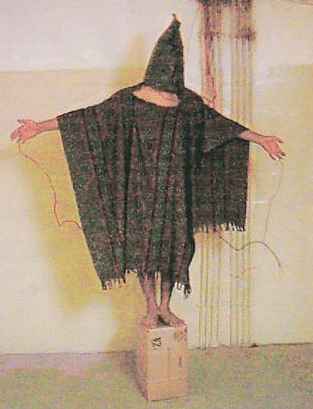
In 2004, it was Major General Antonio Taguba’s damning report – then still a classified document – that triggered the prosecution of a number of the soldiers who had committed abuses at the Abu Ghraib prison, in Iraq. Now, in the preface to a detailed study by Physicians for Human Rights, Taguba states that “there is no longer any doubt as to whether the current administration has committed war crimes. The only question that remains to be answered is whether those who ordered the use of torture will be held to account.”
In “Don’t Get Fooled Again” I look into the deceptions and delusions around the use of torture in Iraq, at the evidence which suggests that Abu Ghraib was anything but an isolated case, and at the striking parallels between the Abu Ghraib abuses, and the notorious “Stanford Prison Experiment”.


 Richard Wilson's blog