Posts Tagged ‘Don’t Get Fooled Again’
NO2ID – Nothing to hide, nothing to fear?
NO2ID’s hard-hitting video on the dangers of data abuse
Many summers ago I had a temp job as a clerk at a private bank where a number of big-name celebrities held an account. The amiable chap I was working for was just a couple of years older than me, and seemed pretty comfortable in his job, though it was obvious that he found the work inordinately dull. One of the ways he liked to liven things up was to look through the personal details of the bank’s famous clients, and on occasions make prank calls to the private numbers that he’d dug out of the files.
As he was a music fan, millionaire ageing rock stars came in for particular attention. Within days of my starting he’d (amiably) shown me around Paul McCartney’s bank account and told me with pride of his habit of calling up the lead singer of Led Zeppelin, whispering “Robert Plant, ha ha ha!” and then hanging up.
A few years later, soon after the death of my sister, we got a knock on the door from the Daily Mail. We had long been ex-directory, and were being meticulously careful about our contact with the media, but the Mail had managed to track us down nonetheless. For years I was mystified about how they might have done it, and it was only when I read Nick Davies’s “Flat Earth News” that I found a plausible answer. Tabloid newspapers had long been in the habit of paying private investigators to track down people they wanted to contact, and it was an open secret that the PIs were bribing civil servants at the DVLA to hand out people’s personal details. Anyone who earned a legally-registered car could be found by the Sun or the Mail at a few hours’ notice. Maybe that was how they found us.
I was reminded of all of this yesterday when I had a fascinating chat with Phil Booth, the national co-ordinator of the NO2ID campaign. The standard reply to anyone who objects to compulsory ID cards, and the attendant mega-database that the government plans to introduce, is that only those with something to hide will have something to fear from it. But this relies on the assumption that every official with access to the database can be trusted to behave with absolute integrity at all times. No-one will ever be tempted to look up the details of their favourite (or least favourite) celebrity and make prank calls to them. No-one will ever take a bribe from a tabloid journalist, or an identity-fraudster, or a deranged ex-husband looking to settle a grudge.
According to NO2ID, the government databases that currently exist are already being used in unauthorised ways on a massive scale. A monthly audit of just one local authority database reportedly found thousands of instances of data being used in ways beyond that originally intended and authorised. Many of the infringements were no doubt minor, but the sheer volume clearly highlights the huge gap between the intended purpose of a government “power” and the practical reality of its use.
It’s this gap between intention and reality that the “nothing to hide, nothing to fear” mantra fails to address. As I argue in “Don’t Get Fooled Again”, one deeply engrained feature of the human psyche seems to be a tendency to over-estimate – sometimes catastrophically – our capacity to control what goes on in the world – and to under-estimate the potential for unintended consequences.
We assume that making something illegal – be it the use of drugs or the abuse of our personal data – is the same thing as stopping it from happening. We assume that giving the authorities unfettered power to detain, torture or even kill those suspected of engaging in some social evil – be it drugs, crime or terrorism – will a) make the problem better rather than worse b) only affect those who’ve been up to no good. Time and again we remain blind to the gap between intention and reality until thousands of innocent people have already been subjected to horrific abuses.
The phrase “nothing to hide” works so well as propaganda because – like many good propagandistic phrases – it means two entirely separate things. “Nothing to hide” is generally taken to be synonymous both with “doing nothing wrong”, and with “no secrets from anyone”. Yet there are plenty of people who have done nothing wrong but might nonetheless have very strong reasons for wanting to keep some things secret from somebody. As NO2ID points out, these include:
those fleeing domestic abuse; victims of “honour” crimes; witnesses in criminal cases; those at risk of kidnapping; undercover investigators; refugees from oppressive regimes overseas; those pursued by the press; those who may be terrorist targets.
A series of embarrassing data breaches have shown how hard the government finds it to keep our personal details secure even now. The more information is stored centrally, and the more people can access it, the more opportunity for abuse and incompetence there will be – with potentially very serious consequences for those who, quite legitimately, do have something to hide.
And neither are we bound to accept that there is anything intrinsically wrong, in and of itself, with wanting to keep things about ourselves secret. The assumption often underlying discussions about the government’s uber-database plan seems to be that the onus is on opponents to explain why we shouldn’t be required to surrender all of our personal information to the authorities, rather than on the government to explain why this move is actually necessary.
At the heart of all this is a fundamental question of principle over who “owns” our personal data, and who is best placed to keep it secure. After half an hour speaking to Phil Booth, I’m more convinced than ever that, both on the principles and the practicalities, this government is fighting a losing battle.
AC Grayling on the human rights “sceptics”
From The Guardian
Critics of the UDHR and of the idea of human rights in general are of many kinds, but the three chief camps consist of the complacent, the inconvenienced and the disappointed. The former are those who, born, bred and fattened in peaceful and reasonably sane parts of the world, have the luxury of caviling and complaining at will, sometimes arguing that there is no such thing as a right, that talk of human rights is variously Eurocentric colonialist arrogance, or hot air, or pious claptrap, or all three. A few days in a windowless cellar with periodic episodes of water-boarding and electric cattle-prodding would change these minds faster than most.
The inconvenienced range from those who think one man is worth two or more women and therefore do not like talk of equality and rights, to those who (like Jack Straw and his new friends at the Daily Mail, from which his predecessor David Blunkett seemed to get most of his policy ideas in the days that followed Labour’s first flush of reform – led by Jack Straw’s Human Rights Act: what irony) have punitive and coercive instincts, and wish not only to lock people up or deport them, but make them suffer extra penalties while doing so, out of revenge and hostility.
The disappointed are those who point to the continuing mayhem, genocides, wars, use of torture and long detention without trial – by would-be respectable western governments too – and say that fine talk about human rights has made not a jot of difference, and indeed has often served as a fig-leaf for abuses.
Of these three camps the third has by far the most cogent point. But what one should draw from it is not defeatism, but renewed determination to make the idea of human rights work. In any case we are, from the long view of history, in the very earliest days of trying to construct a world order, a global sentiment, in which concern for human rights is widespread and operative. Enforcement is the key issue, and here we are in even earlier days: the International Criminal Court, for example, is an infant that does not yet walk. To give up on the idea of human rights now, so soon into the project of trying to remedy the world by its light, would be wrong… The campaign for human rights is the best hope for humankind, and it would be dereliction not to work to make that hope bear fruit.
David Irving – Free speech defender?
See also: The parallels between AIDS denial and Holocaust negationism
It’s becoming something of a modern media tradition that whenever freedom of expression is discussed on TV, the pseudo-historian David Irving needs to be wheeled out to talk about the trials he has faced over his denial of the holocaust. Irving was famously jailed in Austria for a while after falling foul of the country’s laws that make denying the holocaust a criminal offence. Irving had given an inflammatory speech in Austria in 1989 which resulted in the case being initiated, and was arrested and put on trial when he returned in 2005.
I don’t doubt that there are some interesting (well, mildly interesting) questions around the wisdom and morality of locking people up for telling lies about the holocaust. The writer Deborah Lipstadt has argued that such measures are heavy-handed and counter-productive. Far more effective, she argues, to confront and expose a racist liar rather than giving him a chance to make a play for the moral highground by claiming martyrdom.
Lipstadt is in a good position to make this call. In 2000, Lipstadt’s legal team trounced David Irving in court, after he had sued her libel for describing him as a falsifier of history, a liar, an anti-semite and a holocaust denier. Armed with some of the most draconian and plaintiff-friendly libel laws in the western world, Irving had sought to impose a heavy penalty on Lipstadt for her criticisms of him. The move had backfired disatrously. Lipstadt had definitively proven her criticisms of Irving to be true, and helped in the process to destroy what was left of his reputation as a historian.
Irving, it seems, is a supporter of free speech only when it suits him. He has sought actively to use Britain’s libel laws to suppress legitimate criticism of his work, and arguably has rather more in common with the litigious fraudster Robert Maxwell than with the likes of Gandhi and Aung San Suu Kyi…
In “Don’t Get Fooled Again” I look at David Irving’s pseudo-history as a classic example of “bogus scepticism”.
The Sun comes out for democracy
For years, The Sun newspaper and its erstwhile political spokesman Trevor Kavanagh have firmly supported UK government demands for ever more “sweeping new powers” to bug, monitor and jail us without charge and with minimal oversight. Two days ago, the newspaper was still demanding – albeit with a certain amount of cognitive dissonance – that the police be allowed to “detain suspects for as long as they need”.
But the arrest of Sally Murrer, combined with the government’s suicide attack against the last remnants of its reputation seems to have brought about a change of heart.
“We are a police state here and now”, declares Trevor Kavanagh in today’s Sun.
I used to think ID cards were a good thing. What law-abiding citizen could object to these new weapons against terrorists, rapists and murderers? Nothing to hide, nothing to fear. Not any more… If Damian Green can be banged up for nine hours for telling the truth, what hope for you and me? …
The Government’s kneejerk abuse of anti-terror laws as a political weapon is increasingly sinister. It uses them on any pretext – even freezing the economy of friendly Iceland recently when its banks went bust… Soon, unelected snoopers will be able to pry into our mobile calls, text messages and emails. These are the alarming consequences of an authoritarian regime that sees the state as paramount and the people as pygmies.
The Sun says…
It’s hardly news that pundits and columnists often talk at cross purposes and contradict themselves, but to do so within two paragraphs of the same article takes some talent.
Today’s Sun newspaper editorial begins in a familiar vein:
IT is shocking that Indian authorities believe British-born Pakistani terrorists took part in the Mumbai massacre. If true, it proves we have still not learned the lessons of London’s 7/7…
That is why we must give our security services the surveillance powers they require. And we must let police detain suspects for as long as they need.
Then in the next paragraph we are told:
The arrest of Tory immigration spokesman Damian Green is a terrible blow to our democracy. Mr Green was pounced on in raids involving 20 anti-terrorist cops. His homes and offices were searched and his private files and computers seized. His Commons room was turned over apparently with the consent of Labour Speaker Michael Martin. Why was MP Mr Green treated like an al-Qaeda bomber?
The answer, at least in part, is that newspapers like The Sun have, for years, slavishly supported every New Labour demand for “sweeping new powers” to bug, and detain indefinitely on vaguely-defined charges anyone who they say might be a terrorist.
All the while the government has been progressively widening the definition of “criminal” or “terrorist” activity – amid barely a squeak of protest from the supine tabloid media.
That paranoid state officials would end up using these arbitrary powers to harass critics and attack opposition politicians was completely predictable.
In “Don’t Get Fooled Again” I look at the strange nexus between politicians who stoke public fears about terrorism in order to extend their own power, and tabloid newspapers that make their money from enthusiastically regurgitating every torture-tainted government scare story.
Echoes of Sally Murrer case as senior UK opposition politician arrested by counter-terrorism police
In “Don’t Get Fooled Again” I highlight the extent to which government demands for “sweeping new powers”, ostensibly to protect public security, often lead to those powers being used in ways far beyond those originally intended. One among many recent examples was the use of anti-terrorist legislation to freeze Icelandic assets in the UK.
Now counter-terrorism police have arrested the Conservative shadow Home Office minister Damian Green, after he published documents recently released by a government whistle-blower. Green was charged with “aiding, abetting, counselling or procuring misconduct in public office”.
Following his release on bail, Damian Green said:
“I was astonished to have spent more than nine hours under arrest for doing my job. I emphatically deny that I have done anything wrong. I have many times made public information that the government wanted to keep secret, information that the public has a right to know.
“In a democracy, opposition politicians have a duty to hold the government to account. I was elected to the House of Commons precisely to do that and I certainly intend to continue doing so.”
Interestingly, this charge closely resembles the spurious case brought against the local journalist Sally Murrer, in an apparent attempt to intimidate the police whistleblower Mark Kearney. According to the Press Gazette, Murrer was charged with aiding, abetting, counselling or procuring Kearney to commit the offence of “misconduct in a public office”.
Human Rights Watch on the deadly consequences of UN wishful thinking in Congo

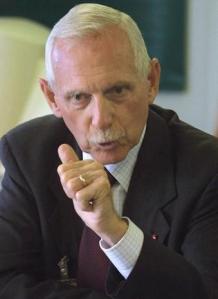
UN Congo chief William Swing withheld
evidence of DRC government atrocities
From Human Rights Watch
The United Nations and a number of bilateral donors invested significant financial and political capital in the [2006] Congolese elections, one of the largest electoral support programs in the UN’s history. But with the polls finished, they have failed to invest comparable resources and attention in assuring that the new government implements its international human rights obligations. For donor governments, concern about winning a favored position with the new government took priority over halting abuses and assuring accountability…
Donor governments said they would devote considerable financial and technical resources to security sector reform programs, but have yet to insist that such programs include adequate vetting to rid the military and law enforcement services of individuals in senior positions who have been implicated in serious human rights violations…
Following the killings in Bas Congo in February 2007, MONUC [the UN peacekeeping force in Congo] sent a multi-disciplinary team to investigate. Its report was not published for five months as it was deemed “too sensitive.” UN officials did not want to criticize the new government before securing its agreement on the role of MONUC in the post-electoral period. Similarly MONUC delayed publication of its report on the March 2007 events for fear of upsetting relations with Kabila.
Both reports were blocked by the head of MONUC, Ambassador William Swing, who deflected repeated requests from the UN Department for Peacekeeping Operations (DPKO) in New York and from the then UN high commissioner for human rights, Louise Arbour, for the reports to be made public.
If the reports had been promptly published, they could have contributed to wider awareness of the serious violations committed and might have led to additional diplomatic pressure on the Congolese government to halt the abuses and hold the perpetrators accountable. The March 2007 investigation report was eventually published in French on January 4, 2008, after a copy was leaked to the press; no English version has been made public.
The Naturalist on the crucial difference between fact and fantasy
From The Naturalist
About the most crucial distinction we can make as cognitive creatures is between appearance and reality, between how things seem and how they really are, between subjectivity and objectivity. We learn, often the hard way, that our impressions and cognitions are sometimes biased, truncated, or in the worst case simply missing. We reach what we assume is the bottom of a stairway, stepping confidently out onto the floor, only to find ourselves plunging yet another step down. We’re sure Congress will pass the (first) 700 billion dollar bailout bill, only to discover in the closing minutes that Republican constituencies will have none of it. For a century we blithely go about our energy consuming, carbon-emitting ways only to discover we’ve been heating up the planet. It seemed our way of life was sustainable; in reality it wasn’t. It seemed (at least to some of us insouciant investors) that unregulated mortgage-based securities could coexist with a stable financial system, that they represented real wealth, but in reality they didn’t. In countless matters great and small we stand corrected in our perceptions and assumptions by feedback from the world. With some notable exceptions to be discussed below, we are perforce commonsense empiricists, wanting to operate under the guidance of an adequate model of reality so that our projects come to fruition. The possibility that we could be mistaken in our modeling should always be present to us, prompting us to gather data in advance of action. If we’re smart we test the waters – depth, purity, temperature – before diving in.
Groupthink, Self-serving bias, Space Cadets and the Stanford Prison Experiment – “Don’t Get Fooled Again” at the Beyond Words book festival
Earlier this week I had a very enjoyable afternoon discussing “Don’t Get Fooled Again” at University College School’s “Beyond Words” book festival, and looking at some of the more eye-catching bits of psychological research that I came across while writing the book. The audience had some challenging and wide-ranging questions, and I thought it might be interesting to post some more background links here.
I was about halfway through my research when I realised that a great many of the delusions I was looking at seemed to come down, at least in part, to what might once have been called “excessive vanity”: The conspiracy theorists who think that they alone are part of some special group with special knowledge about AIDS/the Illuminati/911 or the “great asbestos scam” while everyone else muddles along in their brainwashed ignorance. Or the crank who’s convinced that, just by using his uncommon “common sense”, he’s managed to find a fatal flaw in a well-established scientific theory that generations of world-renowned biologists have somehow contrived to miss.
But what I hadn’t known was the degree to which almost all of us seem to over-rate ourselves and our own abilities, at least to some degree. The average driver thinks that they’re a better driver than the average driver – and reason dictates that we can’t all be above average. Most people also seem to rate themselves at least slightly better than others in intelligence, and significantly better in warmth, generosity and – my personal favourite – likelihood of leaving the largest slice of pizza for someone else when there are only two slices left. The research link for that particular claim can be found here – and for a more general overview I’d recommend Cordelia Fine’s excellent book “A Mind of Its Own: How your brain distorts and deceives”.
Somewhat less academic but still very interesting was the case of a reality TV show called “Space Cadets” where a Channel Four production company managed to convince a group of contestants that they were being sent into space and put into orbit around the earth. In fact they were sitting in a Hollywood space shuttle simulator at a disused military airbase in Suffolk.
The programme-makers had set out explicitly to recreate a psychological phenomenon known as “groupthink”, where members of a close-knit social group become so focussed on a particular group belief or objective that they lose their ability to think critically. But what hadn’t been predicted was the effect that the experience would have on the actors who were in on the hoax, and whose job it was to pretend to be an ordinary member of the group.
“My poor brain is a scramble of half-truths, astronomical lies and unbridled lunacy”, Skelton wrote in the Guardian, shortly after the hoax was finally revealed.
“I’ve just scribbled a list of what I know for sure: I’ve been a mole on a fake reality show called Space Cadets; I have a Russian doll in my hand luggage; I’ve just spent the past five days in a flight simulator in a hangar on the Suffolk coast; and – last but by no means least – I’ve just spent the past five days in space.
My default brain position aboard Earth Orbiter One was that we were 200 kilometres up, travelling at about seven kilometres per second. Too many things were telling me that for me to think otherwise.”
The psychological manipulation had been so strong that even though Skelton knew, rationally, that
the whole thing was a hoax, he found himself believing it anyway.
The third case study I looked at was the notorious Stanford Prison Experiment, which took place in the early 1970s. Researcher Philip Zimbardo constructed a model prison in the basement of the Stanford Psychology Department, and got a group of students to play the roles of prison guards and prisoners. Within days, a significant proportion of the guards, who just days previously had been seemingly normal college students, had been transformed into brutal sadists, who relished the power that they’d been given and the opportunities for abuse that it gave them. In the end, the experiment had to be terminated early. Full details about the experiment and its wider implications can be found at Zimbardo’s excellent Stanford Prison Experiment website.
Interestingly, when the soldiers implicated in the horrific Abu Ghraib prison abuse scandal were put on trial, Philip Zimbardo was one of the key witnesses for the defence, arguing that the “situational pressures” on the guards, stemming from the way the prison had been mismanaged, made such abuses entirely predictable.
In “Don’t Get Fooled Again” I argue that human beings are rather more vulnerable to delusion and manipulation than we are usually be prepared to admit – but that confronting these vulnerabilities, and doing our best to understand them, is crucial in reducing our risk of being fooled in future.
“Misinformed”, “substantially misleading” and “absurd” – the UK government’s verdict on Christopher Booker’s claims
The Sunday Telegraph columnist Christopher Booker has been taking some flack this week over his latest bogus claims on global warming. This in turn has triggered renewed scrutiny of Booker’s denialism on other issues – particularly his assertions about white asbestos, which I examine in “Don’t Get Fooled Again”.
I thought it might be useful to collate some of the responses to Booker’s articles over the years from the UK government’s Health and Safety Executive. Most are letters to the editor, correcting false statements that Booker has made about the HSE and its work. Only the first appears to have been accepted by the Sunday Telegraph for publication – the newspaper usually refuses to print letters which contradict Booker’s bogus claims.
Christopher Booker’s articles on the dangers of white asbestos (Notebook, Jan 13, 27, Feb 10) are misinformed and do little to increase public understanding of a very important occupational health issue.
–Timothy Walker, Director General, Health & Safety Executive, February 2002
The articles in the Sunday Telegraph by Christopher Booker entitled “Fatal cracks appear in asbestos scam as HSE shifts its ground” and “Booker wins asbestos battle” (11 December) highlighted aspects of the current Health and Safety Commission consultation on changes to the asbestos regulations.
While we welcome the emphasis in the articles on evidence-based policy making, I need to correct a comment about our views. While risks from white asbestos may be significantly lower than the risks from blue or brown, HSE does not agree that white asbestos poses no medical risk.
-Jonathan Rees, Deputy Chief Executive, Health and Safety Executive, December 2005
The Health and Safety Laboratory’s research does not confirm that white asbestos in textured coatings poses “no health risk” (Christopher Booker, 6 August). In its report for the Health and Safety Executive, the Laboratory found rather that the level of asbestos fibres in the air from work with textured coatings will not exceed the proposed new lower control limit when carried out using good practice.
Chrysotile asbestos, as found in many textured coatings, is classified as a category 1 carcinogen hazardous by inhalation by both the World Health Organisation and the EU.
-Geoffrey Podger, Chief Executive, Health and Safety Executive, August 2006
HSE does not exaggerate the risks of white asbestos cement fibres as claimed by Christopher Booker (Farmers face £6 bn bill for asbestos clean up’ 25 May). The article was substantially misleading…
The HSE paper quoted in the article in fact makes no specific statement about the risks of asbestos cement. It provides a summary of risk estimates for mesothelioma and lung cancer in relation to blue, brown and white asbestos across a range of exposures. Blue and brown asbestos are substantially more hazardous than white, but all three types can cause mesothelioma and lung cancer.
Finally, HSE in no way promotes the interests of the asbestos removal industry and it is absurd to suggest otherwise.
-Geoffrey Podger, Chief Executive, Health and Safety Executive, May 2008
“Way of the Woo” questions Booker’s latest claim on global warming
From “Way of the Woo”:
Did you hear NASA announced that last month was the hottest October on record? No? How about now:
The world has never seen such freezing heat
On Monday, Nasa’s Goddard Institute for Space Studies (GISS), which is run by Al Gore’s chief scientific ally, Dr James Hansen, and is one of four bodies responsible for monitoring global temperatures, announced that last month was the hottest October on record.
That was from the opinion pages of The Telegraph, “Britain’s No. 1 quality newspaper website”. The Investor’s Business Daily says in their Editorial/Opinion section:
Cold, Hard Facts
Despite record snows and low temperatures around the world last month, a major Al Gore supporter says October was the hottest on record.
And Barbara Sowell of the Digital Journal piles on:
Another Dagger in the Heart of Global Warming Advocacy
When GISS made the announcement last week it was shocking. All over the world were reports of unseasonal cold temperatures and record snowfalls. Even the U.S. National Oceanic and Atmospheric Administration registered 115 lowest-ever temperatures for the month of October.
Were you shocked by last week’s announcement? NASA announcing that “October was the hottest on record” is certainly a headline grabber and I have to admit that I was shocked…shocked that my Google newsfeed didn’t pick up on this story. I checked the major news outlets…ABC, CBS, NBC, CNN, FOX, etc. I was shocked to find that none of them carried any mention last week of this historical data point in the Global Warming timeline. Of these, only FOX news has posted a quick paragraph on the matter by Britt Hume:
In Hot Water
Last week, NASA’s Goddard Institute for Space Studies — one of the four bodies responsible for monitoring global temperatures used by the United Nations — announced last month was the hottest October on record. That was because the institute’s maps showed a 10-degree increase across parts of Russia.
So why didn’t responsible news organizations write a story about NASA’s announcement? You’re not going to believe this but there was no announcement. Christopher Booker, who wrote the original Telegraph article, made it up. Call it a lie, a fantasy, or Booker’s dream story…but it never happened. What did happen was that NASA’s Goddard Institute for Space Studies (GISS) posted an erroneous data point in their monthly tabulation of global temperature data. A glitch or a program error (or whatever) caused large sections of Russian temperature data from September to be carried over into October. That is, their particular data was duplicated, causing the overall global average temperature to be artificially high. The new data point would suggest that last October was indeed the hottest October on record.
NASA did not issue a press release, did not hold a press conference, did not send out news bulletins…they did not even so much as attempt any kind of ballyhoo around this new figure. Understand that James Hansen would practically drool over such a figure because it would, in the midst of our current economic turmoil and the transition of government power, bring the topic of manmade Global Warming back to the fore.
See also: ““The Bias and Logical Fallacies of Christopher Booker’s ‘Freezing Heat’” and “Global warming data blunder: Worth the fuss?”
A little bit of history repeating itself… George Monbiot on the lies told in the run-up to the First World War
From The Guardian
Another anniversary, almost forgotten in this country, falls tomorrow. On November 12 1924, Edmund Dene Morel died. Morel had been a shipping clerk, based in Liverpool and Antwerp, who had noticed, in the late 1890s, that while ships belonging to King Leopold were returning from the Congo to Belgium full of ivory, rubber and other goods, they were departing with nothing but soldiers and ammunition. He realised that Leopold’s colony must be a slave state, and launched an astonishing and ultimately successful effort to break the king’s grip and free Congo’s enslaved people. For a while he became a national hero. A few years later he became a national villain.
During his Congo campaign, Morel had become extremely suspicious of the secret diplomacy pursued by the British Foreign Office. In 1911, he showed how a secret understanding between Britain and France over the control of Morocco, followed by a campaign in the British press based on misleading Foreign Office briefings, had stitched up Germany and very nearly caused a European war. In February 1912, he warned that “no greater disaster could befall both peoples [Britain and Germany], and all that is most worthy of preservation in modern civilization, than a war between them”. Convinced that Britain had struck a second secret agreement with France that would drag the nation into any war which involved Russia, he campaigned for such treaties to be made public; for recognition that Germany had been hoodwinked over Morocco; and for the British government to seek to broker a reconciliation between France and Germany.
In response, British ministers lied. The prime minister and the foreign secretary repeatedly denied that there was any secret agreement with France. Only on the day war was declared did the foreign secretary admit that a treaty had been in place since 1906. It ensured that Britain would have to fight from the moment Russia mobilised. Morel continued to oppose the war and became, until his dramatic rehabilitation after 1918, one of the most reviled men in Britain.
Could the Great War have been averted if, in 1911, the British government had done as Morel suggested? No one knows, as no such attempt was made. Far from seeking to broker a European peace, Britain, pursuing its self-interested diplomatic intrigues, helped to make war more likely.
Germany was the aggressor, but the image of affronted virtue cultivated by Britain was a false one. Faced, earlier in the century, with the possibilities of peace, the old men of Europe had decided that they would rather kill their children than change their policies.
Richard Norton-Taylor on the UK authorities’ latest abuse of the “national security” trump-card
In “Don’t Get Fooled Again” I argue for ultra-scepticism about government trump-card excuses for evading public accountability.
Recent years have seen a profusion of unverifiable claims from UK politicians about the disasters that would result from them coming clean about what they’ve been up to. These range from catastrophic breaches of “crown copyright”, “commercial confidentiality”, and “MPs privacy”, to the joker played by cornered politicians the world over, that revealing the truth would damage “national security”.
One of the most transparently bogus cases in recent months has been the revelation that the UK government withheld, for four years, a police report accusing the Foreign Office of “inconsistency and contradictions, falsehoods and downright lies” in its handling of the notorious Julie Ward murder case.
The authorities claimed, preposterously that “national security” would be compromised if their mendacity was publicised – and have still made no apology for this additional abuse of power.
More worrying still, according to the Guardian’s Richard Norton-Taylor, the UK Parliament’s Intelligence and Security Committee is now urging that the government award itself sweeping new powers to suppress any news story that it chooses to regard as a threat to “national security” (for which, going on past form, we might reasonably substitute “the reputations of government ministers”).
Norton-Taylor writes that:
it is ironic that some members of the cross-party committee – chaired by former foreign office minister Kim Howells – is using “national security” in defence of their quest for new ways to curb the media precisely at a time the high court is inviting editors to oppose the government’s use of “national security” to cover up extremely serious allegations.
Two high court judges have invited the media to challenge the goverment’s claim that information relating to the mistreatment and, it is alleged, torture, of Binyam Mohamed, a British resident detained in Guantánamo Bay cannot be disclosed for reasons of “national security”.
Ministers first obtained the information from the US. Britain’s national security in this case means the American threat to stop sharing intelligence with the UK if the information is revealed.
Jacqui Smith, the home secretary, has asked the attorney general to investigate possible “criminal wrongdoing” by MI5 and the CIA by colluding in torture. The ISC has not been told the full story of the role of Britain’s security and intelligence agencies in the Mohamed case and others involving the secret rendition of terrorist suspects by the CIA.
The parliamentary committee should regard the media not as an enemy, but as an ally in the search for the truth behind “national security” claims and as a protector of fundamental rights.
Harvard study blames Mbeki’s AIDS denial for 330,000 deaths
In “Don’t Get Fooled Again” I trace the growth of the insidious cult of AIDS denial, from its origins in the US in the early 1980s, to the moment it was embraced by the South African government of Thabo Mbeki.
The economist Nicoli Nattrass has estimated that 340,000 lives could have been saved had Mbeki not blocked the distribution of lifesaving drugs, under the influence of AIDS “dissidents” including the virologist Peter Duesberg, who insists that HIV does not cause AIDS and is harmless.
Now a study by the Harvard School of Public Health has arrived at a very similar figure, estimating the death toll resulting from Mbeki’s decision to withhold the drugs as “more than 330,000”. The prominent South African HIV treatment access campaigner Zackie Achmat has called for Mbeki to be held to account for his government’s failure, either through a judicial inquiry, or a revived “Truth and Reconciliation Commission”.
Veteran Liberal MP’s asbestos industry links exposed
The Daily Mirror has picked up on a story that’s been doing the rounds in Rochdale for a while – the revelations about dubious links between the veteran Liberal MP (now retired) Cyril Smith and the asbestos manufacturer, Turner and Newall. Documents recently obtained by local campaigners show that during the early 1980s, as public health concerns over asbestos grew, Smith wrote to the company – whose factory was based in his constituency – asking them to write him a speech which he would then read out in Parliament, passing it off as his own independent view. In the speech, Smith claimed that “the public at large is not at risk”, but failed to reveal that he was simply parroting the industry’s line. The following year it was disclosed that Smith owned 1,300 shares in Turner and Newall. Smith was unrepentant when questioned recently about the case by the Mirror: “Of course the speech was extremely useful to me because it made it sound as if I could speak intelligently on a subject I knew little about”.
Don’t Get Fooled Again and Real England at the Radical Bookfair
I’ve just come back from a brief but very enjoyable trip to Edinburgh, where I was giving a talk on “Don’t Get Fooled Again” at the Radical Bookfair, organised by Word Power books. I was speaking alongside Paul Kingsnorth, who talked about his excellent book “Real England”, charting the damaging effects of top-down economic development on local communities across the country.
Paul traces the problem, at least in part, to the dominant and still largely unquestioned assumption that economic growth must trump all other public ‘goods’ – particularly those which are less easily measured and enumerated – and the belief that any form of development constitutes ‘progress’ – even when this involves the destruction of longstanding local traditions.
I’m still getting the hang of book talks, so I kept mine simple (perhaps overly so, given the sophistication of the audience). I focussed on the bogus claims made by the UK government – and aggressively hyped by large sections of the media – in the run-up to the war in Iraq, and putting forward the argument I make in “Don’t Get Fooled Again” that we need a law to make lying in public office a criminal offence.
The event really came alive when the audience got involved – one of the first points from the floor came from a former Labour councillor and MEP, who identified the common thread between both talks as the lack of democratic accountability. The same political disenfranchisement that gave local people so little say over the changes being imposed from the ‘top down’ on their communities was at work even at the heart of the Blair government – where the full facts about Iraq were kept to a tiny circle of people around the Prime Minister, with other cabinet members often being kept in the dark.
Other contributors talked about the difficulty of knowing which parts of the media to trust, given that even peer-reviewed scientific journals are subject to a form of ‘selection bias‘. Where scientific research has been commissioned by a commercial enterprise, such as a pharmaceutical company, that company may have a vested interest in submitting for publication only the results which present their products in a positive light, while quietly shelving studies that tell a less rosy story.
In response to one question, I mentioned an excellent website where the UK government’s bogus claims about Iraqi WMD have been forensically broken down by the writer Chris Ames. As I couldn’t remember the full details, I thought it might be useful to post the link here. I also thought it might be helpful to give some links to three excellent media watchdog websites, the Center for Public Integrity, the Media Standards Trust, and Sourcewatch.
Paul Kingsnorth pointed out how ironic it is that so much sound and fury has been raised over the punishment to be meted out to two comedians leaving lewd ansaphone messages when so little has been done to hold to account the senior politicians who took us into a disastrous war on bogus grounds.
It was fantastic to be able to meet so many people who had read and enjoyed “Don’t Get Fooled Again”, and having spent so much time recently dodging brickbats in various online discussions, it was very refreshing to have a proper, civilised face-to-face discussion. My only regret was that I couldn’t stay for longer – due to family commitments I had to rush back to London that same day – but I very much hope to do more of this kind of thing in future.
But by far the most surreal moment – in a good way – came just before I was due to go on and speak, when I caught sight of the man who had been my boss’s boss’s boss many years ago when I was still working in London as a profoundly unsuited IT bod. It turns out that Peter Cox, formerly the systems director of a major UK retail firm, has now reinvented himself as a writer, first with a book about English cricket, and now with “Set into Song” – an in-depth look at the music of Ewan MacColl, Charles Parker, Peggy Seeger. Peter was due to give a talk about his new book later that evening, but unfortunately I had to head back.
On the way home I had a chance to read a lot more of Paul Kingsnorth’s fascinating book, which works both as an engaging portrait of many important – yet often ignored – aspects of England, and also has some interesting things to say about the current state of our political system. Best of all, the book got totally trashed – twice – by those fascinating folks over at Spiked Online, which (unless you believe that climate change science really is a racist liberal conspiracy to demonise the working classes) has to be something of a badge of honour. I’m looking forward to finishing it.
Outgoing chief prosecutor warns against “mediaeval delusions” and “the paraphernalia of paranoia”
Ken MacDonald, the outgoing chief prosecutor of England and Wales, has warned against paranoid fears over terrorism being used to justify giving the government ever more “sweeping powers”, the BBC reports.
“We need to take very great care not to fall into a way of life in which freedom’s back is broken by the relentless pressure of a security state”, he said in his final speech.
Following the heavy defeat of government proposals to allow itself to detain people for 42 days without charge, Home Secretary Jacqui Smith has announced plans to create a giant database to monitor the telephone, email and internet usage of everyone in the UK – ostensibly on the basis that this will help to fight terrorism. Opposition parties have described the plan as “Orwellian”.
In his speech, Ken Macdonald urged resistance to what he called the “paraphernalia of paranoia”:
“Of course, you can have the Guantanamo model. You can have the model which says that we cannot afford to give people their rights, that rights are too expensive because of the nature of the threats we are facing.
“Or you can say, as I prefer to, that our rights are priceless. That the best way to face down those threats is to strengthen our institutions, rather than to degrade them.
“We would do well not to insult ourselves and all of our institutions and our processes of law in the face of these medieval delusions.”
In “Don’t Get Fooled Again” I look at the strange nexus between journalists who whip up public fears over terrorism in order to sell more newspapers, and politicians who exaggerate the threat so as to justify their demands for ‘sweeping powers’ to invade our privacy, evade public scrutiny, and control our behaviour.
Don’t Get Fooled Again, a public forum with with Richard Wilson and Paul Kingsnorth, at the 12th Edinburgh Independent Radical Book Fair 2008
Out of the Blue Drill Hall
30-38 Dalmeny Street
Edinburgh
EH6 8RG
Scotland
UK
Admission Free! Donations welcome!
All Welcome!
Cafe and Bar Open!
Why is it that intelligent and educated people are, time and again, fooled by ideas that turn out to be nonsense? From different perspectives Richard Wilson and Paul Kingsnorth discuss the impact of deception and delusion on our daily lives.
Richard Wilson is the author of Don’t Get Fooled Again: The Sceptic’s Guide to Life .
‘…provides the reader with the analytical tools to avoid being taken for a ride, as well as being entertaining and informative.’ Patrick Neale, The Bookseller
Paul Kingsnorth is the author of One No, Many Yeses. His Latest book is Real England: The Battle Against the Bland .
‘An understated but still very effective polemic about the damage done to our real quality of life over the last few decades, and our collective failure to do very much about it.’ Jonathon Porritt , Chairman, Sustainable Development Commission


 Richard Wilson's blog